
The Forest in Light: Science and Experience
What can we learn from looking?

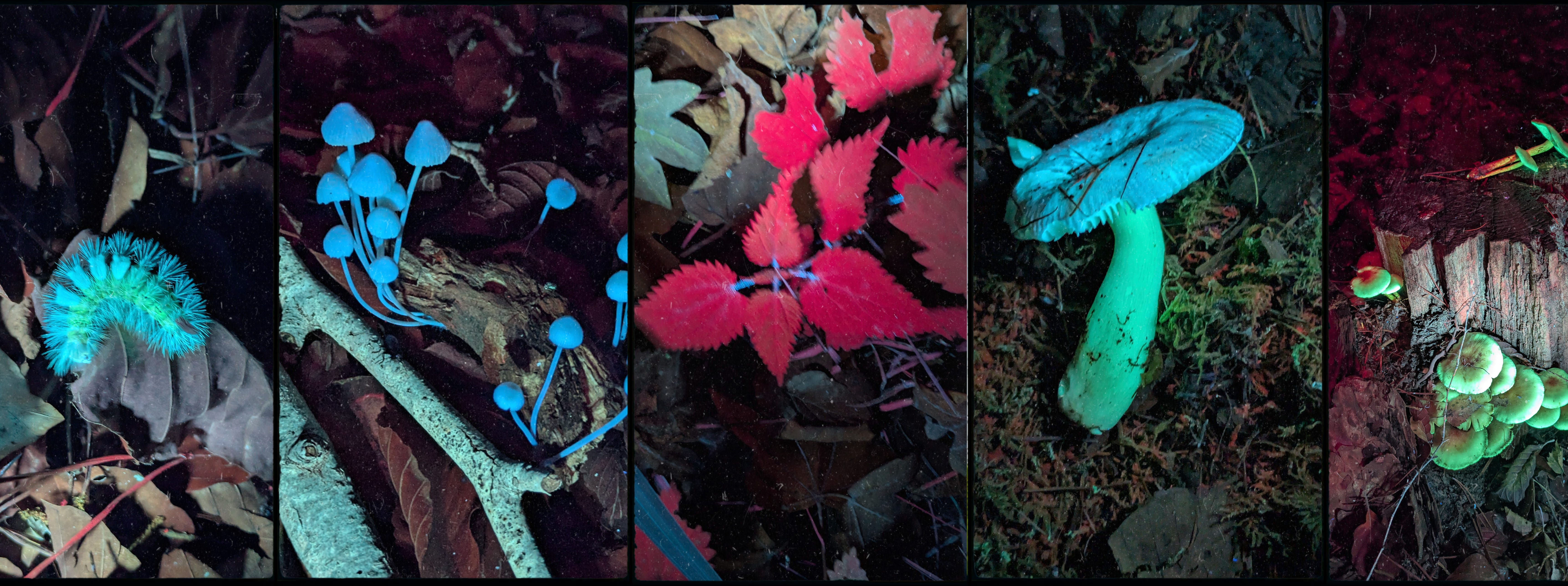
I started autumn in the forest going out at night with a UV torch looking for biofluorescence. Biofluorescence is something responding to light by reflecting it back, rather than generating its own lightsource. Nature produces biofluorescence all around us but we can’t normally see it.
Walking the forest with a UV torch, I found the vivid golden-green of sulphur tuft mushrooms, and brittlegills with electric blue caps and highlighter yellow stems. There was a sleepy caterpillar glowing multi-colours and a slug that oozed yellow which turned vibrant blue. The forest itself had become strangely beautiful too. Chlorophyll in leaves glows a deep, bright red under UV light, turning my surroundings into the kind of landscape you see on old Doctor Who episodes. This is such an established piece of knowledge now that UV satellite photography is being used to monitor crop and forest health.
There’s a lot of talk at the moment about how science and technology can improve our relationship with nature. Trees are being given voices through electrode monitoring, whilst more and more studies look at the way humans interact with and respond to the natural world in the hope that we can incorporate what we learn into the design of our urban environments.
But, for a long long time, architects have known that we respond better and feel a greater sense of wellbeing when surrounded by nature. Throughout history, grand architecture has employed fractals to achieve our peak aesthetic. The concept of fractals is, at its most basic level, a pattern within which each element resembles the pattern as a whole.
The Fractal Fluency Model illustrates the human inclination toward fractals, finding a preference for statistical fractals (those most found in nature) that have a mid-range complexity. High complexity fractals are things like snowflakes or the blood vessels in an eye. Low complexity fractals might be the coastline of a country, or a geothermal rock pattern. Mid-range fractals are waves, clouds and trees.
Richard P. Taylor, University of Oregon and Branka Spehar, University of New South Wales found that the human visual system has adapted to mid-range fractals specifically. This makes them easiest for us to discern and navigate, therefore more likely to feel aesthetically pleasing and have the knock-on effect of reducing our stress levels.
Beyond fractals, nature gives us colour and light too. Studies have pretty well established the benefits of greenery even on a physical level. A Beijing-based study by Zhang C, Wang C, Guo X, Xu H, Qin Z, Tao L. found a connection between the amount of greenness around schools and a reduction in myopia risk (the most common refractive error causing short sightedness and near sightedness) in adolescents.
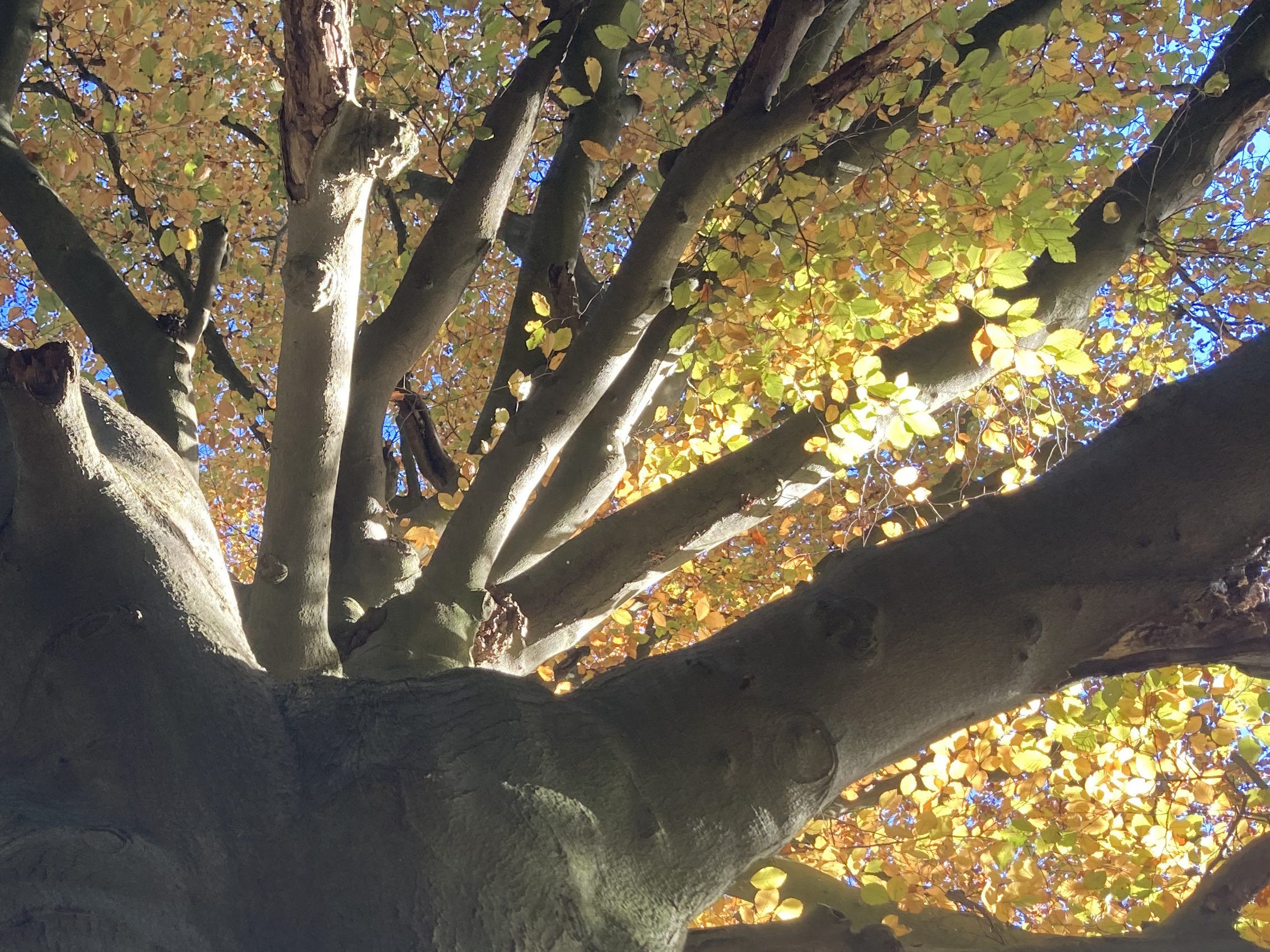
But, as summer fades from memory in misty mornings and cold nights, the greenness also starts to go. Leaves this time of year change colour, either due to the breaking down of the green (or red under UV) chlorophyll, or the greater production of anthocyanins. Does this mean they suddenly lose their ability to give us health benefits? What about the effect of orange light on the human body?
I couldn’t find any studies into the effects of orange leaves on humans. But Gilles Vandewalle at the University of Liège, and Howard Cooper at the French National Institute of Health and Medical Research studied the effect of orange light generally and found exposure to orange light gave humans more activity in their prefrontal cortex (involved in higher cognitive function) than those exposed to blue light – which screens emit.
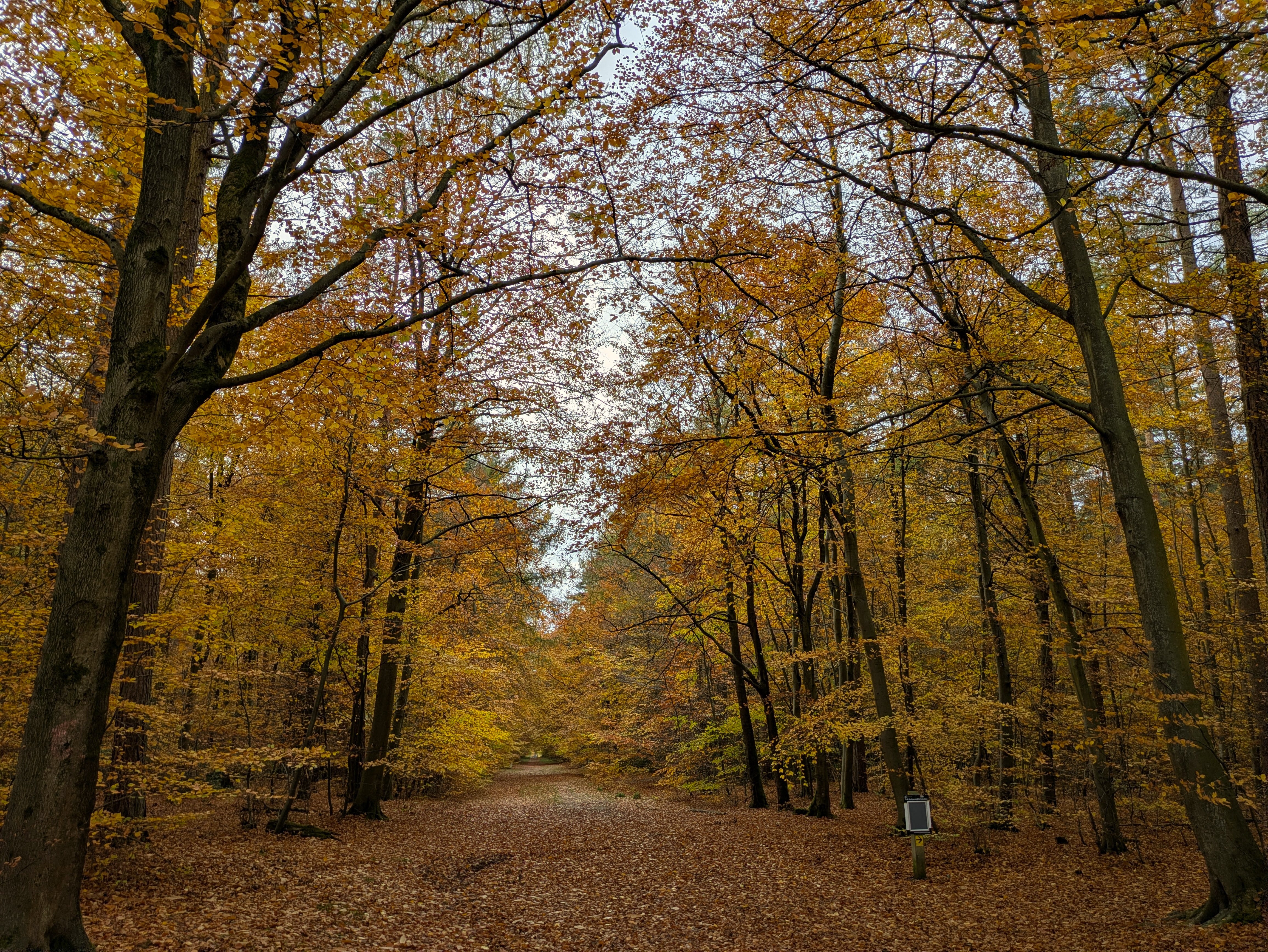
But, to leave science behind for a moment and go anecdotal: driving the roads and walking the paths through Thetford Forest and its conjoined neighbour King’s Forest, I have passed through vibrant tunnels of yellow, orange and red, my eyes awash with a bright, sunny glow. I have felt the physiological impact each time. It’s like the sun breaking through the clouds and bathing your face in light and warmth. Do I need a scientific study to tell me this light improves my wellbeing?
Though, on a scientific though tangentle note, it did remind me of a study I came across years ago. It’s one I think of a lot while I am writing and has arguably nothing to do with leaves or light or human wellbeing.
Neil Roberts and Philip Davis from the University of Liverpool, and Guillaune Thierry, from the University of Wales, studied people’s brain activity while they read Shakespeare. They found specific elements of his language heightened brain activity in readers. For example, using a noun as a verb where we wouldn’t normally, like in the phrase, “he godded me,” allows our brains to immediately understand each word in the sentence but also forces it to momentarily backtrack to work out how to interpret the words used in this novel way. I think about this study whenever I dare myself to do something weird with language!
But I thought about it again when I drove into that glowing orange tunnel of leaves. Humans love novelty. It’s why we invent things and create new pieces of art, it’s why we have affairs and try recreational drugs too. And the joyousness of living in a country with variable seasons is the novelty each new season brings.
It’s fun going out to discover sensory ways of experiencing the world we are not adapted to, like seeing UV-induced biofluorescence, but we don’t need to do that to experience sensory novelty. Each season in the UK brings us a new way to explore: the spring awash with green light and scented blossoms, summer warmth and fruits, autumn mists and fiery leaves, winter’s pale skies and crunching frosts. Surely we know in our bodies this novelty is good for us?
Using science and technology to understand our relationship with nature isn’t a bad thing. The findings of studies and application of technology can enrich our knowledge and help improve our lives and our care of the natural world. However, a lot of the studies conducted really just confirm what we already know instinctively.
We forget, we are not external observers studying the natural world, we are animals and therefore part of it. In the same way a fox knows not to eat an animal that’s been poisoned, or a fish knows where to go for the best breeding pools, or a plant knows to reach for the sunlight, we know, in our skins, what is good and what is harmful. The complicating factor is our ability to choose. Hopefully, the direction science is taking will help us make more informed choices.
What do you think of the use of science to improve our relationship with nature? Have you come across any particularly interesting findings or applications?
If you are interested in finding out more about the studies referenced above, you can follow the links below:
Trees speak up in AI-powered experiment
Effects of Greenness on Myopia Risk